
The Indian Family Office Barometer 2026
A proprietary annual survey of how India's family offices allocate, govern and prepare: the questions the industry discusses at dinner, answered in data for the first time.
- Instrument
- 28 Questions · 5 Modules
- Sample
- Target 50-100 Family Offices
- Cadence
- Annual · Q2 Fieldwork
- Status
- Concept Preview
Every conversation about Indian family wealth relies on the same borrowed numbers: global surveys with a handful of Indian respondents, or anecdotes traded between advisers. The Barometer is designed to replace anecdote with an owned, annual dataset: a structured survey of 50-100 single-family offices and professionally advised families across India and its diaspora, fielded each spring and published each summer. What follows is the inaugural edition as a working prototype: the full instrument, and modelled findings that show how the results would read.
Who answers
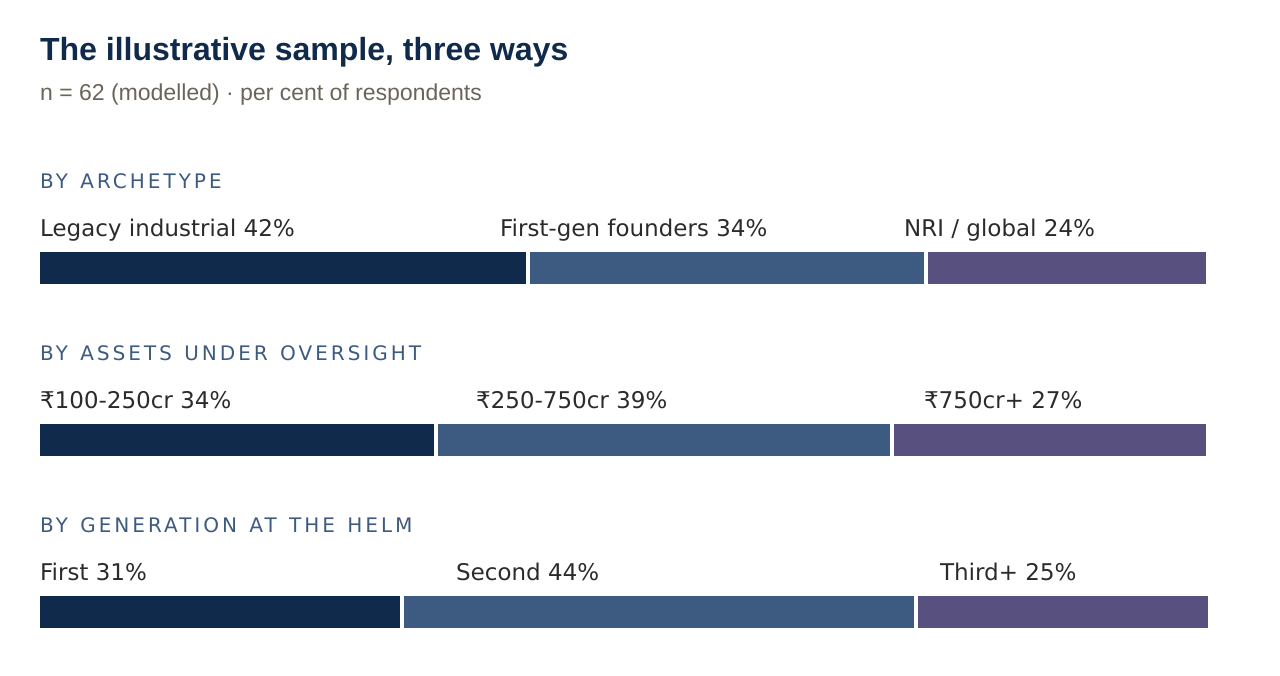
The illustrative sample of 62 family offices spans three archetypes we observe in practice: legacy industrial families (multi-generational operating businesses, typically North and West India), first-generation founders (new-economy wealth, typically post-exit or partially liquid), and globally distributed NRI families managing wealth across two or more jurisdictions.
Where the money sits, and where it is moving
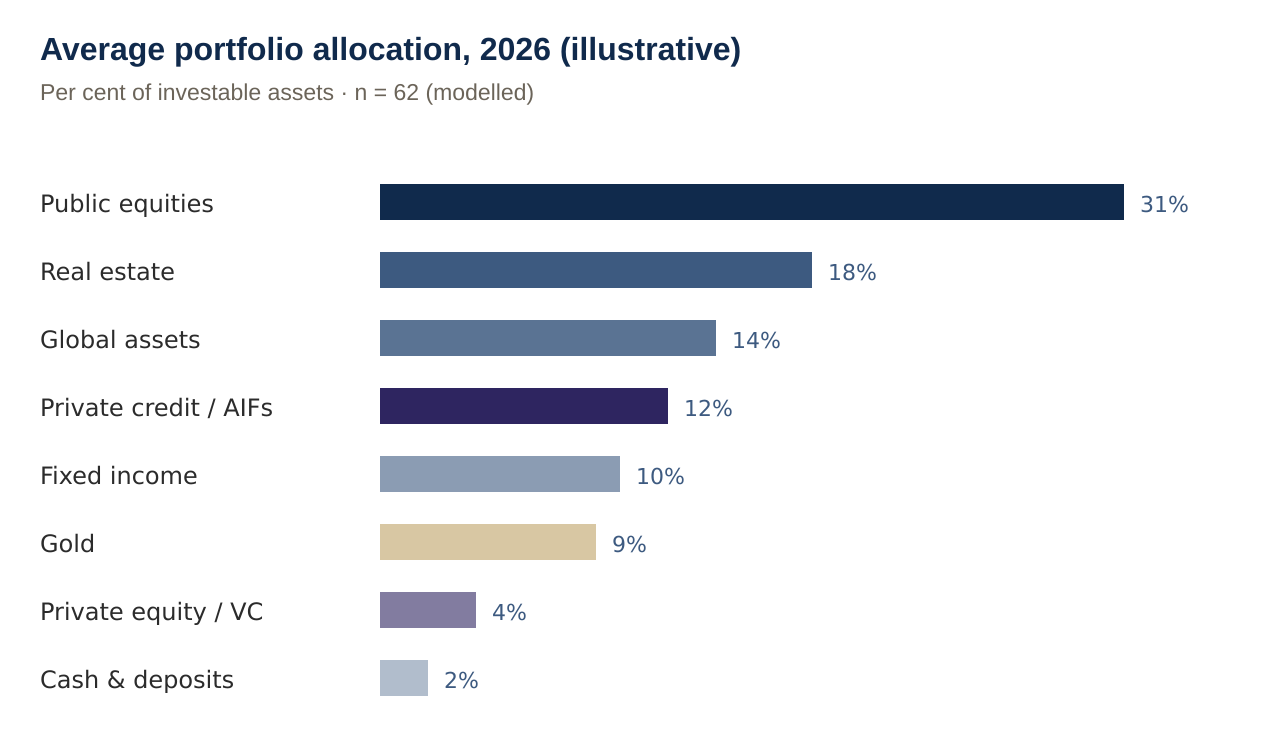
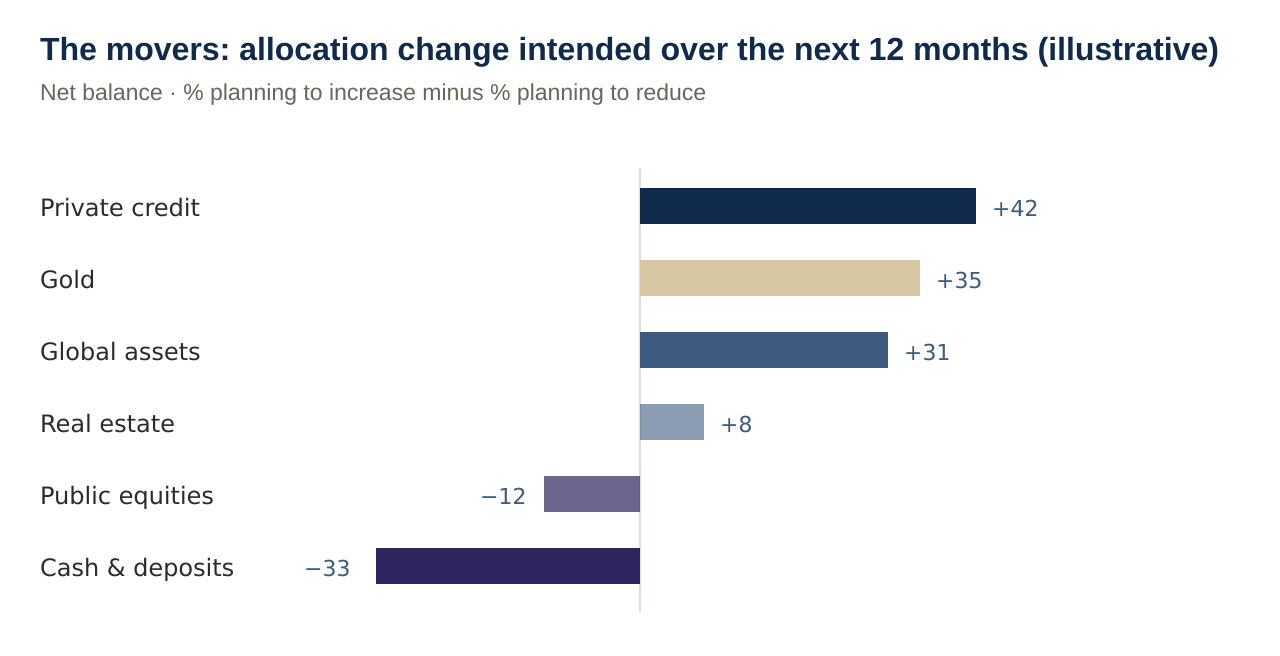
The modelled 2026 allocation tells a story consistent with the year's events: public equity remains the core but has ceded ground; gold and global assets absorbed the geopolitical shock of the spring; and private credit continues its structural climb into family portfolios.
The readiness gap, measured annually
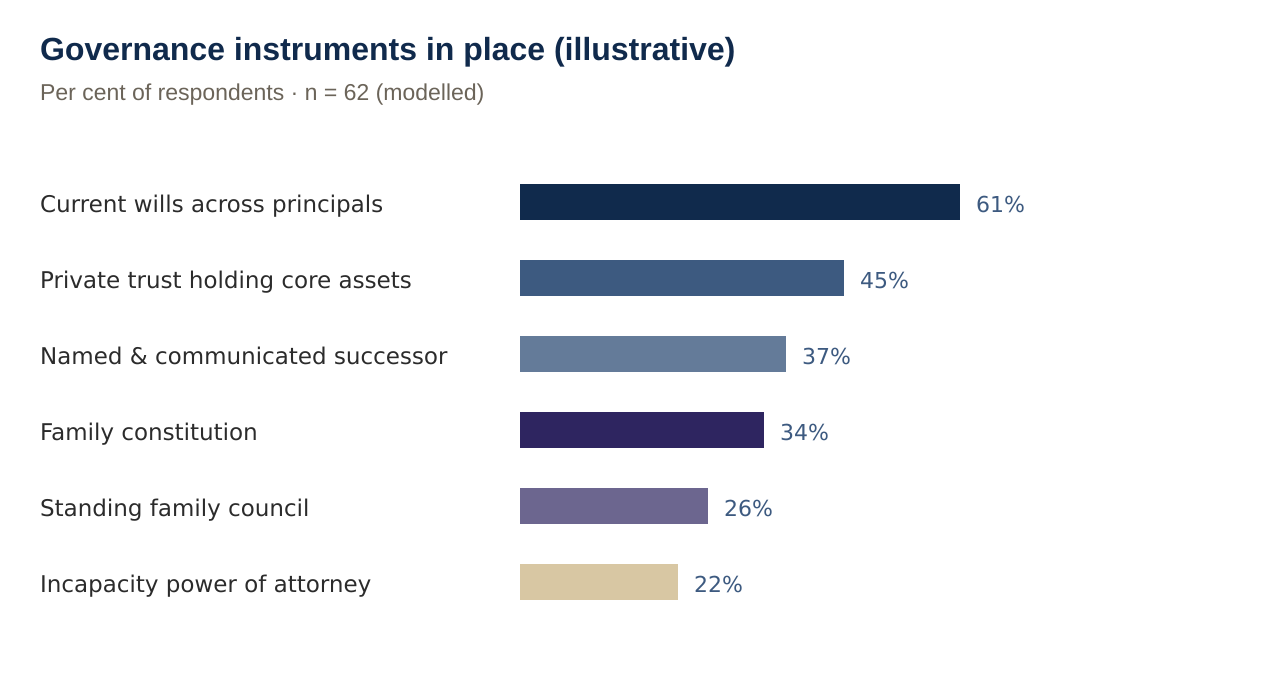
The Barometer's most distinctive series: an annual, like-for-like measure of governance adoption. The modelled inaugural readings echo what public research already suggests (intent far ahead of documentation) and would give India, for the first time, a yearly benchmark against which every family can place itself.
GIFT City, geopolitics, and the year ahead
The remaining modules track structural adoption and sentiment. In the modelled data, 26 per cent of offices hold or are establishing a GIFT City vehicle with a further 40 per cent evaluating one; 71 per cent place geopolitical disruption among their top three concerns for the first time, the spring's events writing themselves directly into allocation intentions; and fee transparency emerges as the adviser-selection criterion respondents rank first, ahead of performance.
Whoever fields this survey owns the reference numbers for Indian family wealth. Every citation is a compounding asset.
The Private Research Desk
The questionnaire, in full
Twenty-eight questions, five modules, fifteen minutes by structured interview or secure form. Banded responses throughout (no family is asked for a precise number), and every response reported only in aggregate. The full instrument is set out below.
How the real edition would be run
Fieldwork each April-May by structured conversation or secure form; banded answers only; a minimum cell size of five before any cut is reported; findings published each July with the full instrument in the appendix; respondent families receive the results privately, two weeks before publication, with a personal benchmark against the aggregate. Participation is unpaid and anonymous; the reward is the benchmark itself.
- 01Which best describes your family office? (Embedded in the operating business / Dedicated single-family office / Professionally advised without a dedicated office)
- 02Assets under the office's oversight, in bands. (₹100-250cr / ₹250-750cr / ₹750cr-2,000cr / above ₹2,000cr)
- 03Which generation currently leads financial decisions? (First / Second / Third or later / Shared across generations)
- 04Where are family members resident? (India only / India + one other jurisdiction / Three or more jurisdictions)
- 05Number of professionals employed by or dedicated to the office, in bands.
- 06Approximate current allocation across: public equities, fixed income, real estate, private credit/AIFs, private equity/VC, gold, global assets, cash. (Banded per class)
- 07For each class: over the next 12 months do you intend to increase, hold, or reduce?
- 08Do you currently invest through SEBI-registered AIFs? (Yes, Cat II / Yes, Cat III / Both / No)
- 09What share of the portfolio is held outside India, in bands?
- 10What role does gold play in the portfolio? (Strategic allocation with a defined band / Tactical / Cultural-ceremonial only / None)
- 11Which alternative asset class do you expect to add first, if any?
- 12What net-of-fee rupee return do you underwrite for the whole portfolio, in bands?
- 13Do all senior family members hold current, witnessed wills? (All / Some / None)
- 14Is any core family asset held in a private trust? (Yes / In progress / Considered and declined / Not considered)
- 15Does the family have a written constitution or charter? (Yes, reviewed within 3 years / Yes, but dated / In drafting / No)
- 16Is there a standing family council or equivalent forum that meets on a set cadence?
- 17Has a successor for business leadership been identified and communicated to the family? (Identified and communicated / Identified privately / Not identified)
- 18Are ownership succession and management succession treated as separate decisions?
- 19Are next-generation members (18-35) engaged in structured financial education or governance today?
- 20If the principal were incapacitated tomorrow, do signing authorities and powers of attorney exist to run the business and portfolio without them?
- 21Does the family hold, or is it establishing, a GIFT City (IFSC) vehicle? (Hold / Establishing / Evaluating / No plans)
- 22Which offshore jurisdictions does the family currently use, if any? (Singapore / DIFC-Dubai / Mauritius / Others / None)
- 23Do resident members utilise LRS annually? (Fully / Partially / Rarely / Never)
- 24Has the family reviewed its cross-border structures against current rules within the last 24 months?
- 25Rank your top three concerns for family wealth over the next three years. (Geopolitical disruption / Succession & family alignment / Currency / Valuations / Regulation & tax / Cyber & fraud / Concentration in the operating business)
- 26Did the events of spring 2026 cause a lasting change to your allocation or structures? (Lasting change made / Temporary adjustments / No change)
- 27What matters most in selecting an external adviser? (Fee transparency / Performance record / Breadth of services / Discretion / Personal relationship)
- 28Would you participate in a closed-door exchange of these results with peer families? (Yes / Perhaps / No)
- 01This is a concept prototype prepared for internal review. All findings shown are illustrative, modelled to demonstrate the reporting format; no fieldwork has been conducted and no family has been surveyed.
- 02Illustrative figures were modelled to be directionally consistent with published Indian family-wealth research cited in the Perspectives library (family office growth, governance adoption, allocation trends), but they are not derived from any dataset.
- 03The questionnaire (28 questions, 5 modules) is original and ready for fieldwork subject to the firm's approval, legal review and pilot testing with three to five friendly families.
Concept preview. Not for external circulation in this form. Threewords Capital Perspectives · Private Research Desk.
The Succession Readiness Index: a private, four-minute diagnostic
Open the diagnostic