
The GIFT City Question: Onshore, Offshore, or Both?
India built a piece of foreign territory on its own soil, and in 2026 the regulator approved its first foreign family investment fund. For families with members and money on both sides of the border, the old Singapore-versus-Mumbai question now has a third answer.
- Author
- The Private Research Desk
- Published
- July 2026
- Reading Time
- 7 minutes
- Classification
- Open Publication
Every Indian family with global members eventually confronts the same architectural question: where should the wealth live? For three decades the honest answer was "partly abroad": a Singapore fund here, a Mauritius vehicle there, a Dubai holding company for the NRI branch. GIFT City, India's International Financial Services Centre at Gandhinagar, was conceived to repatriate that architecture. Treated as foreign territory for financial and exchange-control purposes yet sitting under Indian sovereignty, and governed by a single unified regulator, the IFSCA, it lets capital operate in dollars, under globally aligned rules, without leaving the country.
For years the idea outran the reality. That gap is now closing quickly. In April 2026, the IFSCA approved the first Foreign Family Investment Fund under its 2025 regulations, a milestone that validates GIFT City as a jurisdiction for family offices, cross-border estate planning and global wealth structures, not merely for trading desks. Industry estimates put commitments in GIFT-domiciled alternative investment funds above $12 billion by end-2025, and projections see the centre's fund-management ecosystem crossing $100 billion by 2030.
What the structure actually saves
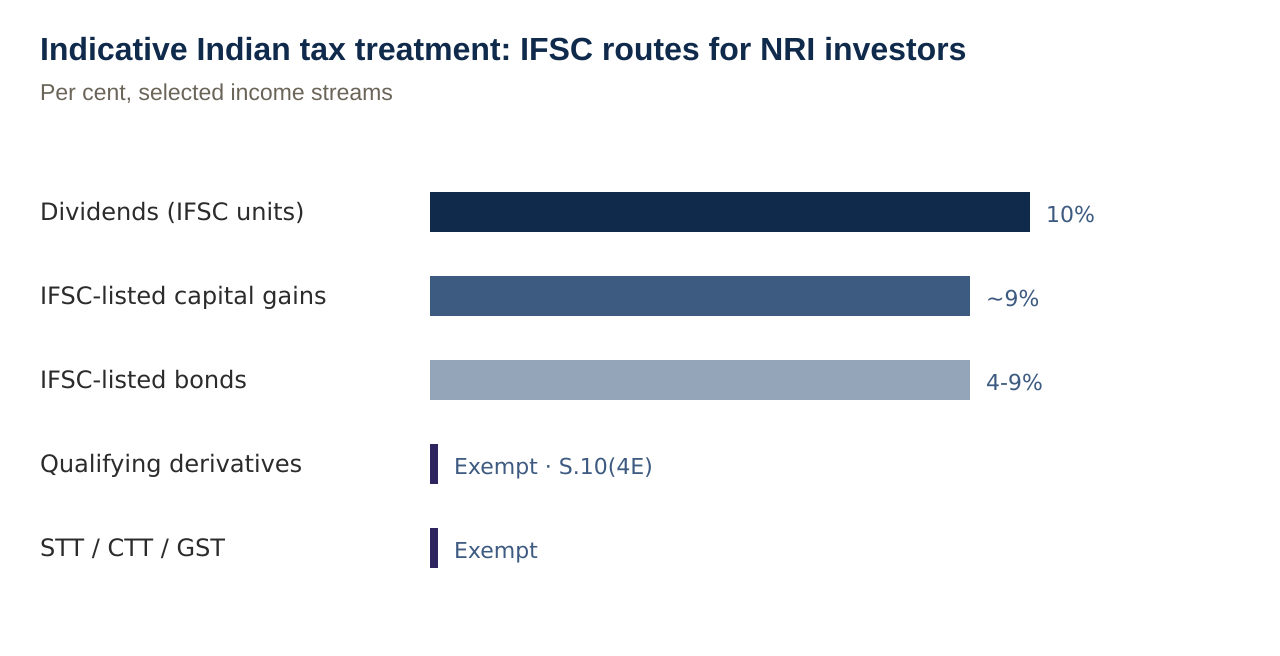
The fiscal architecture is deliberate and generous. IFSC entities enjoy a ten-year tax holiday, with the window extended to 2030. For NRI and foreign investors, dividend income from IFSC units is taxed at a concessional 10 per cent; capital gains on specified IFSC-listed securities attract roughly 9 per cent or, in defined cases, exemption; income from qualifying derivatives with offshore banking units is exempt under Section 10(4E); and IFSC exchange transactions carry no securities transaction tax, commodities transaction tax or GST. Because GIFT City transactions occur in foreign currency, treaty benefits under India's DTAAs remain accessible, without the treaty-shopping anxieties that now shadow Mauritius and Singapore structures.
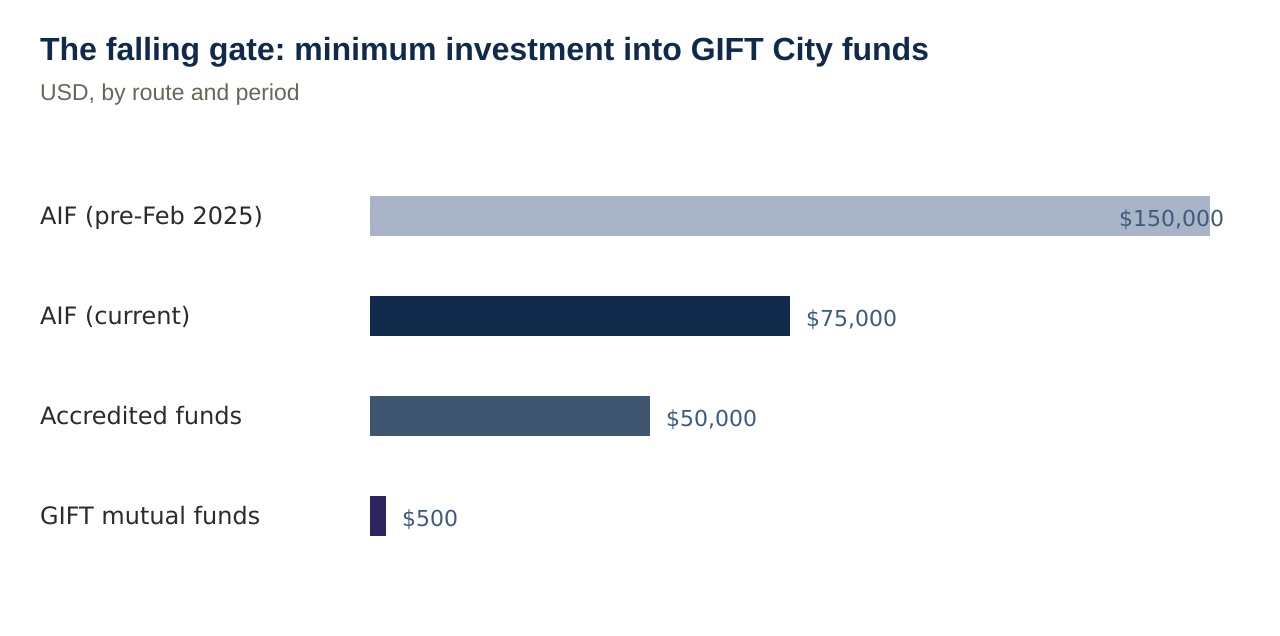
Access has widened as fast as the tax case. SEBI's 2024 decision permitted 100 per cent NRI ownership of GIFT-domiciled funds; the AIF minimum fell from $150,000 to $75,000 in February 2025, with select accredited-investor funds admitting $50,000; and retail-oriented GIFT mutual funds now accept as little as $500. From April 2026, offshore funds can relocate to GIFT City tax-neutrally, an explicit invitation to structures currently sitting in Mauritius or Singapore to come home.
Onshore, offshore, or a third pole
The deeper question for a family is not tax; it is architecture. Resident members can route up to $250,000 per person per year into GIFT vehicles under the Liberalised Remittance Scheme. NRI members can hold dollar assets with clean repatriation and, for US persons, structures (separately managed accounts rather than pooled funds) that sidestep punitive PFIC treatment. The 2026 Iran war added an unplanned argument: families concentrated in a single offshore hub watched regional risk reprice overnight, and GIFT City is increasingly viewed not as a replacement for Dubai or Singapore, but as an additional India-linked base that diversifies jurisdictional exposure itself.
The question is no longer whether to be onshore or offshore. It is whether your structure chart has been redrawn since the rules changed, because the rules have changed.
The Private Research Desk
Where the polish is still drying
GIFT City remains a young jurisdiction. Liquidity on IFSC exchanges trails mature hubs; the professional ecosystem, while growing rapidly, is still shallower than Singapore's; rules continue to evolve, which cuts both ways; and foreign-currency deposits sit outside domestic deposit insurance. US-resident members need country-specific advice before touching any pooled vehicle. Our view: for Indian families with cross-border members, GIFT City has graduated from curiosity to a serious third pole in the structure chart: best entered deliberately, one vehicle at a time, with the family constitution and the tax opinions written before the first dollar moves.
- Bar & Bench, "GIFT City 2026: India's rising magnet for NRI investments" (June 2026): first Foreign Family Investment Fund approved by IFSCA in April 2026 under its 2025 regulations; post-war jurisdictional diversification theme; liquidity and ecosystem caveats.
- Investmates, "How NRIs Can Invest in GIFT City" (2026): tax holiday extended to 2030; AIF minimum cut from $150,000 to $75,000 (Feb 2025); 100% NRI fund ownership (SEBI, June 2024); April 2026 tax-neutral fund relocation; $500-minimum GIFT mutual funds.
- Edelweiss Mutual Fund, "GIFT City Funds for NRIs": 10% concessional dividend tax; ~9% capital gains on IFSC-listed securities; no TDS; DTAA access.
- GoINRI and Savetaxs guides (2026): bond taxation at 4%/9% by listing date; Section 10(4E) derivative exemptions; STT/CTT/GST exemptions.
- Enterslice, "GIFT City AIFs 2026": industry estimates of $12bn+ in GIFT AIFs by December 2025; LRS route of $250,000 per person per year; pass-through status for Category I/II funds.
- GIFT CFO commentary (March 2026): fund-management ecosystem projected to cross $100bn in commitments by 2030.
- Kalviro Ventures, "GIFT City Investment for NRIs" (2026): PMS/SMA route for US persons and PFIC considerations; IBU account requirement; USD deposit rate ranges.
This publication is for information only and does not constitute investment, legal or tax advice. Tax treatment depends on individual circumstances, residency and treaty positions, and rules evolve; obtain professional advice before acting. Figures are drawn from public sources believed reliable as of July 2026 but are not guaranteed. Threewords Capital Perspectives · Private Research Desk.