
Private Credit in India: The Decade's Quiet Compounder
While public markets absorbed shock after shock, an asset class built on lending where banks cannot has grown fifty per cent in a year. For family offices, the question is no longer whether to allocate; it is how to underwrite the underwriter.
- Author
- The Private Research Desk
- Published
- July 2026
- Reading Time
- 7 minutes
- Classification
- Open Publication
India has a paradox at the heart of its credit system. The country is home to thousands of fundamentally sound mid-market businesses (real assets, seasoned promoters, predictable cash flows) that cannot raise timely bank finance because they do not fit the standardised moulds banks are built to serve. Into that structural gap has moved private credit: funds, mostly structured as SEBI-regulated Category II Alternative Investment Funds, lending directly at negotiated terms. The numbers describe an asset class coming of age. Deal value crossed $9 billion across 79 transactions above $10 million in the first half of 2025 alone, according to EY (growth of roughly 53 per cent year on year), while total commitments across the AIF industry climbed to ₹14.2 trillion, about $155 billion.
Industry participants at the IVCA Private Credit Summit this year put the market's current size near $25 billion, expanding at close to 30 per cent annually, against an estimated $500 billion credit gap among mid-sized enterprises. India's private credit-to-GDP ratio remains less than a fifth of the United States'. Read one way, that is immaturity. Read another, it is a decade of runway.
What the premium is actually paying for
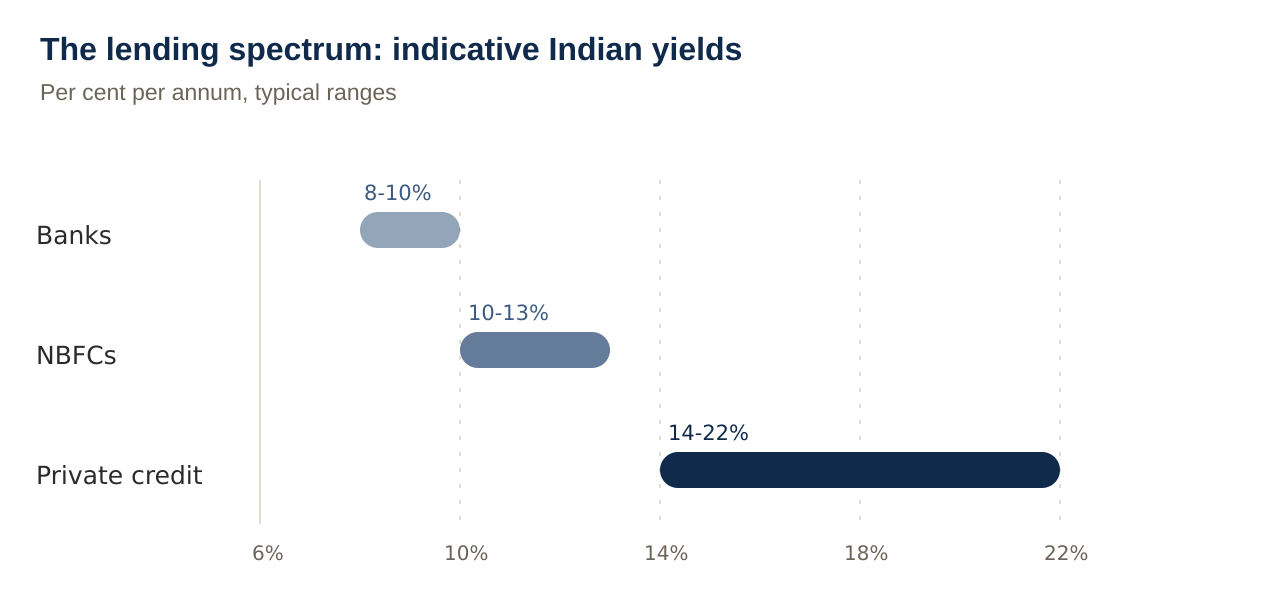
The headline attraction is unambiguous. Indian private credit yields typically range from 14 to 22 per cent, against 8 to 10 per cent for bank lending and 10 to 13 per cent for finance companies, per S&P Global. But the spread is not free money; it is compensation for illiquidity, borrower complexity, bespoke structuring and, critically, the fund manager's underwriting judgment on unlisted, unrated instruments. In this asset class, the manager is not an intermediary. The manager is the asset.
Banks are retreating by design
The opportunity is being enlarged by regulation as much as by demand. Bank credit growth decelerated from over 20 per cent in FY24 to roughly 11 per cent in FY25, and the Reserve Bank's investment directions effective January 2026 cap any single regulated entity at 10 per cent of an AIF scheme's corpus, deliberately cleaving banks from the private credit pipeline and leaving the field to genuine risk capital. Simultaneously, the RBI's April 2026 liberalisation of acquisition finance opens new, adjacent lending frontiers. Real estate remains the dominant use, at roughly 42 per cent of deal volume, from last-mile construction finance to inventory-backed lending, much of it flowing through RERA's governance filter.
HNIs and family offices have become the largest domestic investor pool in Indian private credit. The capital that once sat in fixed deposits is learning to underwrite.
The Private Research Desk
Family capital is central to this story. Large family offices globally hold 15-25 per cent of portfolios in alternatives, with a quarter to a third of that in private credit, and Indian families are converging on the pattern: through domestic AIF commitments of ₹1 crore and above, and increasingly through GIFT City's IFSC route, which admits NRI capital from $150,000 with treaty efficiencies and cleaner repatriation.
How we underwrite the underwriter
Our caution list is short but firm. This asset class has grown up entirely inside an economic upcycle; it has never been tested by a prolonged downturn, a point S&P makes pointedly. Gross-to-net slippage is chronic. Lock-ins of three to six years demand honest liquidity planning, and a "diversified" fund can conceal concentrated exposure to a single developer ecosystem. Taxation matters too: Category II pass-through income is taxed at the investor's marginal rate (around 39 per cent for most families), which reshapes the net case relative to equity alternatives.
Our conclusion: private credit has earned a strategic, not opportunistic, allocation in Indian family portfolios: sized honestly, laddered across vintages, and selected on the manager's recovery record rather than the marketing deck's IRR. The quiet compounder rewards those who read the fine print. Fortunately, reading fine print is our trade.
- EY, Private Credit Report H1 2025, cited in Chambers & Partners "Private Credit 2026 - India": $9bn+ across 79 deals; ~53% YoY growth; AIF commitments of ₹14.2tn (~$155bn) by June 2025; real estate ~42% of deal volume.
- S&P Global, "India's private credit market is coming of age" (Sept 2025): 14-22% typical yields vs 8-10% (banks) and 10-13% (NBFCs); untested downcycle risk; RBI caps of 10%/20% on regulated-entity AIF participation; Julius Bär family office allocation data.
- IVCA Private Credit Summit 2026 coverage (July 2026): ~$25bn market size, ~0.6% of GDP, ~30% CAGR, ~$500bn MSME credit gap; AIF commitments crossing ₹12 lakh crore (Sundaram Alternates).
- PwC India, "Tapping private credit opportunities in India's distressed assets market": Category II AIF structure dominance; private credit-to-GDP below one-fifth of US levels; IBC 2016 and GIFT IFSC as enablers.
- RBI investment directions (effective January 2026) and acquisition-finance liberalisation (effective 1 April 2026), as reported in Chambers & Partners and industry commentary; FY24→FY25 bank credit growth deceleration of 20.2%→11%.
- Industry platform disclosures (2026): GIFT City NRI access from USD 150,000; domestic AIF minimum of ₹1 crore; ~39% marginal pass-through taxation; indicative 18% gross → 13-14% net IRR slippage.
This publication is for information only and does not constitute investment advice, an offer, or a solicitation. Private credit involves significant risk, including illiquidity and loss of capital. Figures are drawn from public sources believed reliable as of July 2026 but are not guaranteed. Threewords Capital Perspectives · Private Research Desk.