
The Strait and the Rupee: Family Capital After the 2026 Iran War
The four-month closure of the Strait of Hormuz was the sharpest energy shock India has faced in a generation. For Indian families of wealth, the lasting lessons are about currency, concentration and the price of unhedged assumptions.
- Author
- The Private Research Desk
- Published
- July 2026
- Reading Time
- 7 minutes
- Classification
- Open Publication
On the last day of February 2026, coordinated American and Israeli airstrikes on Iran set in motion the most consequential energy disruption of the modern era. Within days, Tehran declared the Strait of Hormuz closed and moved to enforce it: mining the waterway, threatening transiting vessels, and choking a corridor that carried roughly a quarter of the world's seaborne oil trade and a fifth of its liquefied natural gas. The International Energy Agency would call it the largest supply disruption in the history of the global oil market.
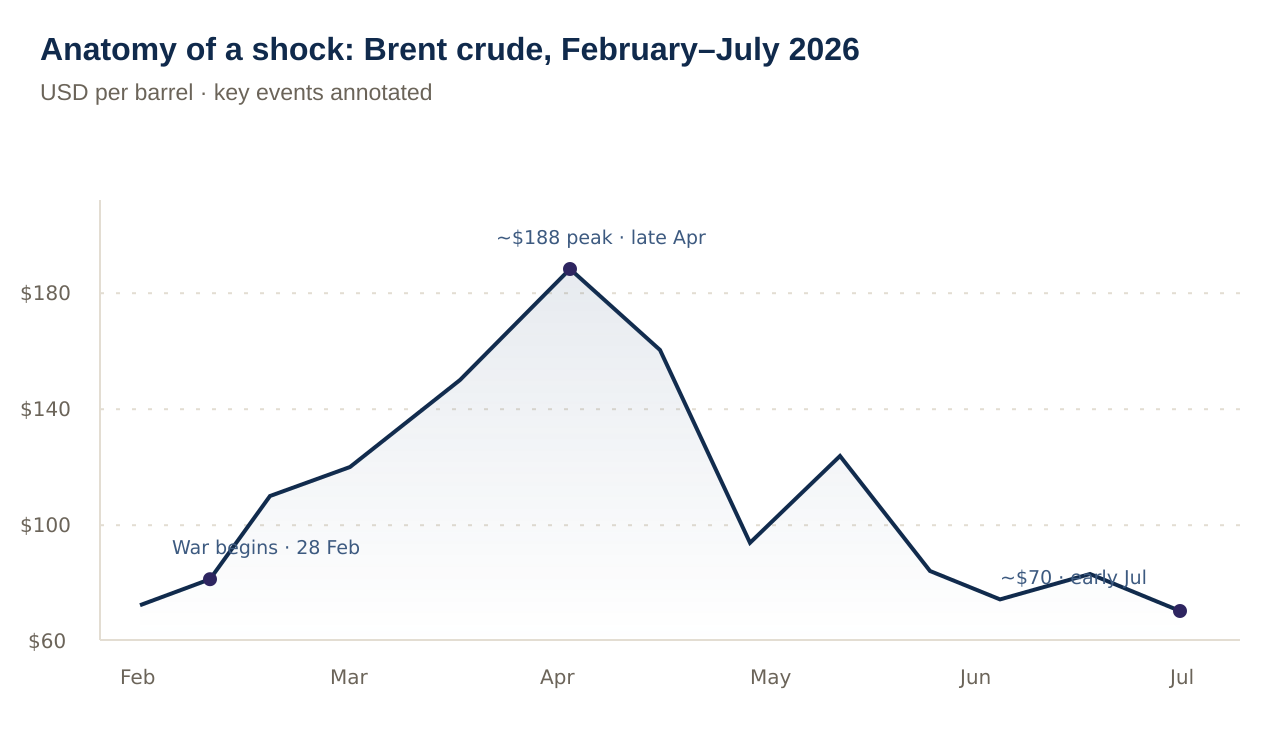
Markets told the story with brutal economy. Brent crude, near $72 on the eve of the war, surged past $120 within the first week of the closure and touched a wartime high above $188 in late April. By early July, after an April ceasefire, a fragile June memorandum of understanding, and repeated flare-ups, it had round-tripped to roughly $70. A commodity that travelled from $72 to $188 and back in four months is not a price chart; it is a stress test. Every family balance sheet in India was, knowingly or not, sitting the exam.
How the shock reached Indian wealth
India imports nearly 90 per cent of its crude, and the war's transmission into Indian assets was swift and textbook. The rupee fell to record lows, breaching 92 to the dollar in March as imported inflation combined with foreign investors pulling roughly $3 billion from Indian equities in a single month. The Reserve Bank of India deployed an estimated $12-15 billion of its reserves defending the currency across spot, forward and offshore markets, and by June faced what economists described as one of its hardest policy calls in memory: hold the 5.25 per cent repo rate to protect growth, or hike to defend the rupee. It held, but the debate itself was the message: an external energy shock had cornered domestic monetary policy.
The fiscal channel was equally direct. State-run oil marketing companies absorbed losses of roughly ₹748 billion in the April-June quarter rather than pass full prices to consumers, a quiet transfer from the exchequer to the petrol pump that every taxpayer of scale ultimately funds.
Russia crosses the fifty per cent line
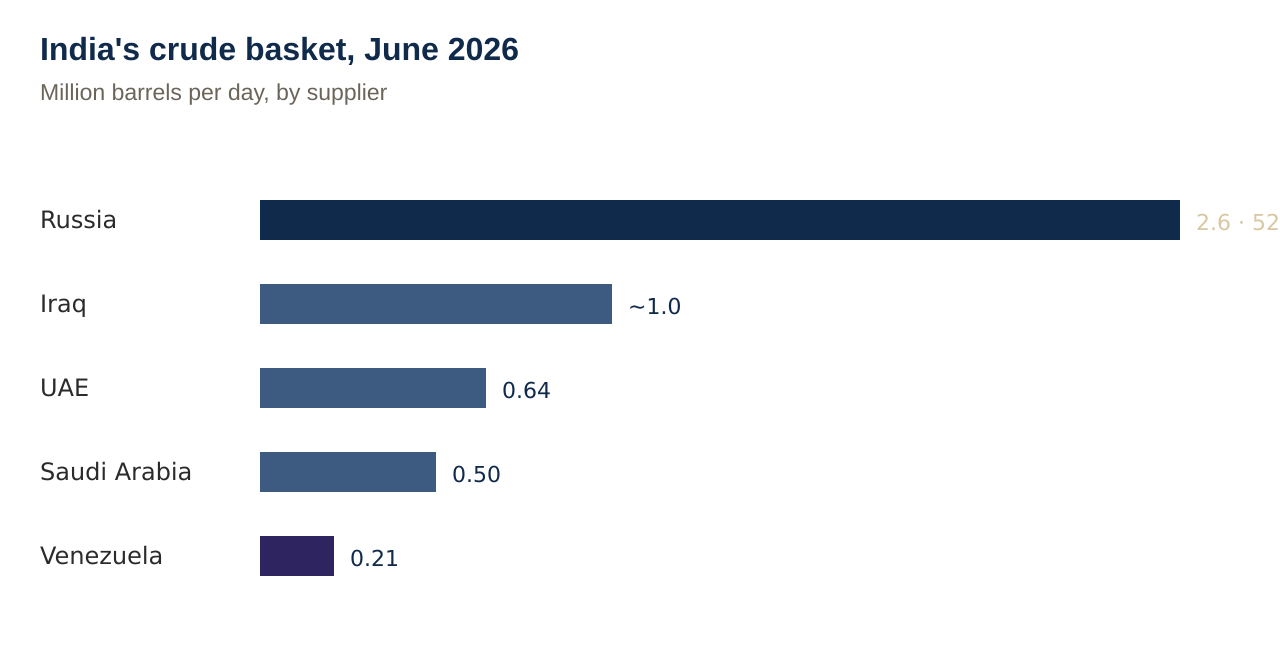
The most durable consequence may be cartographic. With Iraqi barrels (historically India's second-largest source) effectively stranded behind the Strait for four months, Indian refiners pivoted hard. In June, Russian crude supplied more than half of India's import basket for the first time on record, at roughly 2.6-2.7 million barrels per day, while the Middle East's share fell to an all-time low near 38 per cent. Venezuela quietly became a top-four supplier. New Delhi, holding strategic reserves covering barely eight days of imports, has begun planning five new strategic petroleum reserve facilities.
A single supplier now provides the majority of India's crude. Concentration has not disappeared from the system; it has changed its address.
The Private Research Desk
What a family office should take from 2026
First, currency is a position, whether or not it is chosen. A family with 95 per cent of its wealth in rupee assets took a meaningful mark-to-market hit in dollar terms this year without a single portfolio decision being made. Deliberate, compliant diversification (LRS allocations, GIFT City vehicles, offshore structures for NRI members) is not exotic; after 2026, it is hygiene.
Second, the hedges behaved as advertised. Gold and energy-linked assets did the work equity diversification could not, while safe-haven flows into the dollar amplified every unhedged exposure. Third, second-order effects dominated: gas-dependent industrials, aviation and fertiliser businesses (sectors where many promoter families hold operating assets) suffered more than headline indices, a reminder that a family's business and its portfolio often carry the same hidden factor.
The Strait has reopened, tentatively. The premium it taught investors to price has not gone anywhere, and in our view it should now be a permanent line in every Indian family's investment policy statement.
- Congressional Research Service, "Iran Conflict and the Strait of Hormuz: Impacts on Oil, Gas, and Other Commodities," 2026: Strait carries ~27% of world maritime crude and product trade; closure timeline.
- Wikipedia, "2026 Strait of Hormuz crisis" and "Economic impact of the 2026 Iran war": war start 28 Feb 2026; closure 4 March; Brent above $120; IEA "largest supply disruption in history" characterisation.
- CNBC (29 June 2026): Brent $72.45 vs wartime high above $188 in late April; shipping normalisation outlook.
- Axios (14 June 2026): ceasefire-extension announcement; Brent $84.21.
- Business Standard (2 June 2026): rupee at record lows; ~90% import dependence; RBI's 5.25% repo dilemma; April projections of 4.6% CPI and 6.9% growth.
- Anand Rathi PMS research (May 2026): INR breaching 92/USD; ~$3bn March FPI equity outflows; RBI's estimated $12-15bn reserve deployment.
- Kpler/LSEG ship-tracking data via energynews.pro and ThePrint (July 2026): record ~2.6-2.7 mn bpd Russian imports; >50% share; Middle East share at record low ~38%; supplier detail via organiser.org.
- MENA India Corridor / Enterprise (July 2026): OMC losses of ₹748bn in Apr-Jun; strategic reserves of ~39 mn bbl (~8 days); five new SPR facilities planned.
This publication is for information only and does not constitute investment advice, an offer, or a solicitation. Figures are drawn from public sources believed reliable as of July 2026 but are not guaranteed. Threewords Capital Perspectives · Private Research Desk.