
Gold, the Dollar, and the New Non-Alignment
Central banks are buying gold at a pace unseen since the era of fixed exchange rates, and telling surveyors, in record numbers, that they expect to hold less of the dollar. For Indian families, the world's oldest asset has quietly become its newest geopolitical instrument.
- Author
- The Private Research Desk
- Published
- July 2026
- Reading Time
- 7 minutes
- Classification
- Open Publication
Something changed in 2022, and the world's reserve managers have not stopped acting on it since. When roughly $300 billion of Russia's foreign exchange reserves were frozen by Western sanctions, every central bank on earth absorbed the same lesson: a reserve held in someone else's system is a reserve held at someone else's pleasure. Gold (unfreezable, unsanctionable, no one's liability) was the logical response. Official-sector buying roughly doubled after 2021, averaging about 1,000 tonnes a year against roughly 500 tonnes in the preceding decade, and by one Morgan Stanley estimate gold now accounts for a larger share of central bank reserves than US Treasuries for the first time since 1996.
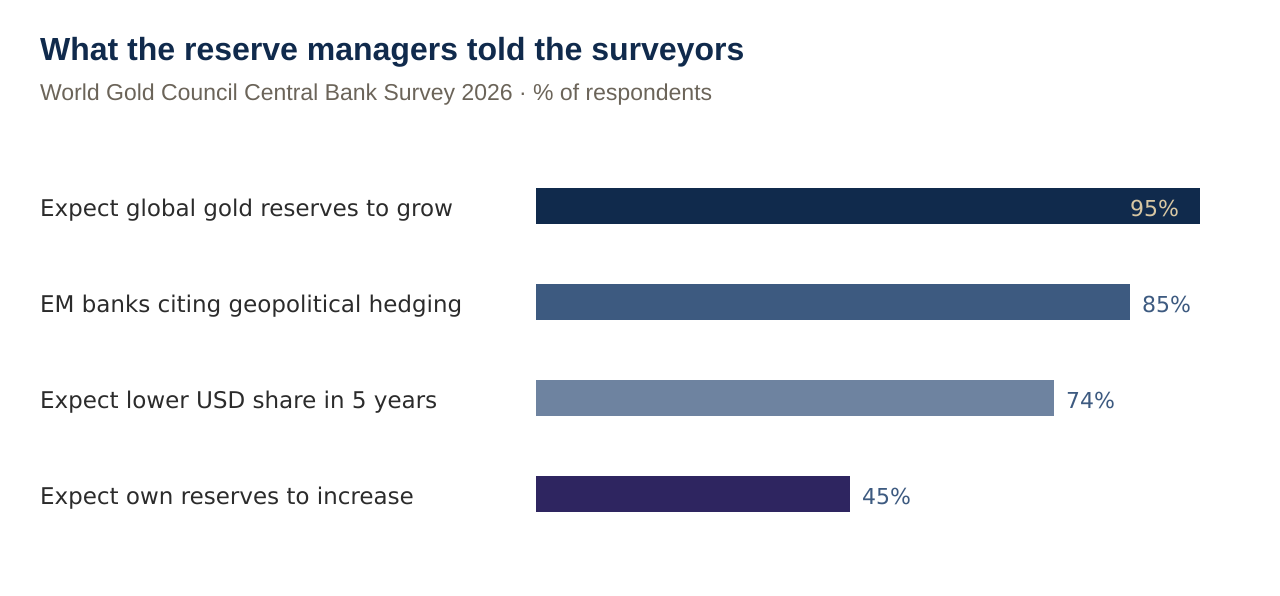
The 2026 numbers say the shift is consensus, not fashion. The World Gold Council's 2026 Central Bank Gold Reserves survey (its largest ever, with 76 institutions responding) found a record 45 per cent of central banks expecting their own gold reserves to rise over the coming year, 95 per cent expecting global official holdings to keep growing, and fully 74 per cent expecting the dollar's share of global reserves to be moderately or significantly lower within five years. Among emerging-market institutions, 85 per cent named geopolitical hedging as a reason to hold the metal. This is what non-alignment looks like on a balance sheet.
A doubling, a war, and a mid-cycle pause
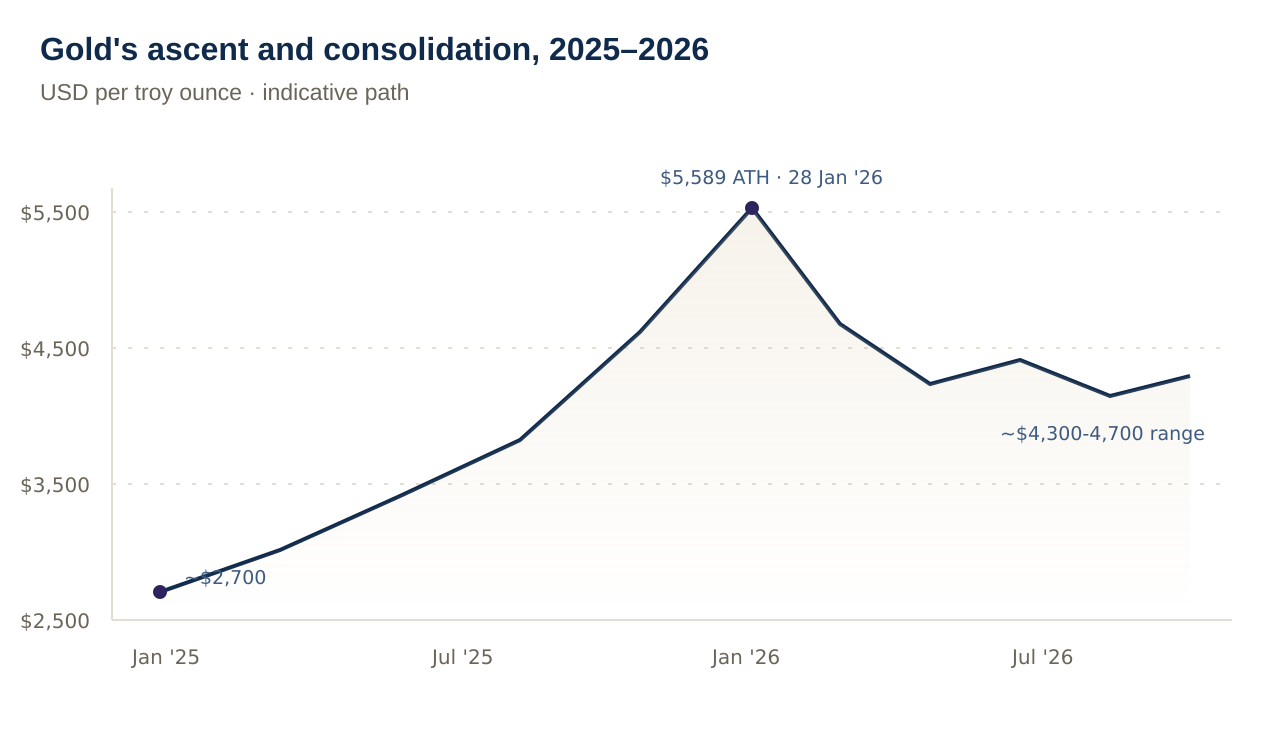
Price has followed policy. Gold roughly doubled between January 2025 and January 2026 (from about $2,700 to beyond $5,400) and printed an all-time high of $5,589 per ounce on 28 January 2026, exactly one month before the Iran war began. The war then cut both ways: safe-haven demand collided with the reality that some oil-dependent states quietly monetised gold reserves to defend their currencies through the energy shock. Since the January peak the metal has consolidated in a broad $4,300-4,700 range through mid-2026, a retracement that looks, against prior bull cycles, like a mid-cycle pause rather than an ending. Forecasters remain constructive: J.P. Morgan's commodities team expects gold to average close to $6,000 by the final quarter of 2026, with central bank demand at the top of its list of drivers.
Central banks buy at $4,000 and they buy at $5,500. When the least price-sensitive buyer in the world is also the most persistent, the floor is not where it used to be.
The Private Research Desk
A civilisation-long position, newly rational
Indian families have never needed persuading on gold; the country's households hold it in quantities central banks envy. What has changed is the character of the case. Gold's 2026 role is not ornament or tradition but the same role reserve managers assign it: the one asset in the portfolio with no counterparty, no custodian politics, and no correlation to a promoter's operating business. The 2026 Iran war made the point locally: as the rupee slid to record lows, gold did in family portfolios precisely what it did on sovereign balance sheets. Asia's institutions are leaning the same way: the People's Bank of China has now bought gold for twenty consecutive months, lifting holdings to 2,346 tonnes, while BRICS+ nations hold 17.4 per cent of global gold reserves, up from 11.2 per cent in 2019.
Our discipline, as ever, cuts against euphoria. Gold pays nothing; a doubling in twelve months borrows from future returns; and the same survey optimism that supports the price can reverse at the margin. We treat gold as a strategic allocation with a defined band: meaningful enough to matter in a crisis, bounded enough that the portfolio does not become a monument to one fear. The new non-alignment is not a bet on the dollar's collapse. It is the refusal to let any single system, however familiar, hold all of a family's options.
- World Gold Council, Central Bank Gold Reserves Survey 2026: record 76 respondents (5 Feb-19 May 2026); record 45% expect their own gold reserves to increase; 95% expect global reserves to grow.
- Bullion Trading LLC survey coverage (June 2026): official-sector buying ~1,000t/yr post-2021 versus ~500t prior decade; 74% expect a lower USD reserve share within five years; 90%/84%/82% crisis-performance, store-of-value and diversification motives; 85% EM geopolitical hedging; J.P. Morgan ~$6,000 Q4 2026 average expectation; $5,589 ATH on 28 Jan 2026.
- ISA Bullion (May 2026): Morgan Stanley finding of gold exceeding US Treasuries in CB reserves for the first time since 1996; WGC-reported 2025 official purchases; BRICS+ share of global gold reserves at 17.4% versus 11.2% in 2019.
- Discovery Alert (May 2026): gold's doubling from ~$2,700 (Jan 2025) to $5,400+ (Jan 2026); consolidation range through mid-2026; Q1 2026 official demand of 244t; the 2022 Russian reserve freeze as trigger.
- IndexBox (July 2026): PBoC's 20th consecutive month of purchases; holdings at 2,346 tonnes; wartime monetisation of gold by some states during the Iran conflict.
- State Street Global Advisors, "Gold 2026 Outlook": 2026 central bank demand projected at 756-1,100t; structural drivers of APAC demand.
This publication is for information only and does not constitute investment advice. Gold prices are volatile and forecasts are not guarantees. Figures are drawn from public sources believed reliable as of July 2026 but are not guaranteed. Threewords Capital Perspectives · Private Research Desk.