
Writing the Family Constitution: Governance Before the Transition
India is preparing for one of the largest intergenerational wealth transfers in its history: an estimated $1.5 trillion over the coming decade. The families that will cross it intact are writing their rules down now, before they are needed.
- Author
- The Private Research Desk
- Published
- July 2026
- Reading Time
- 7 minutes
- Classification
- Open Publication
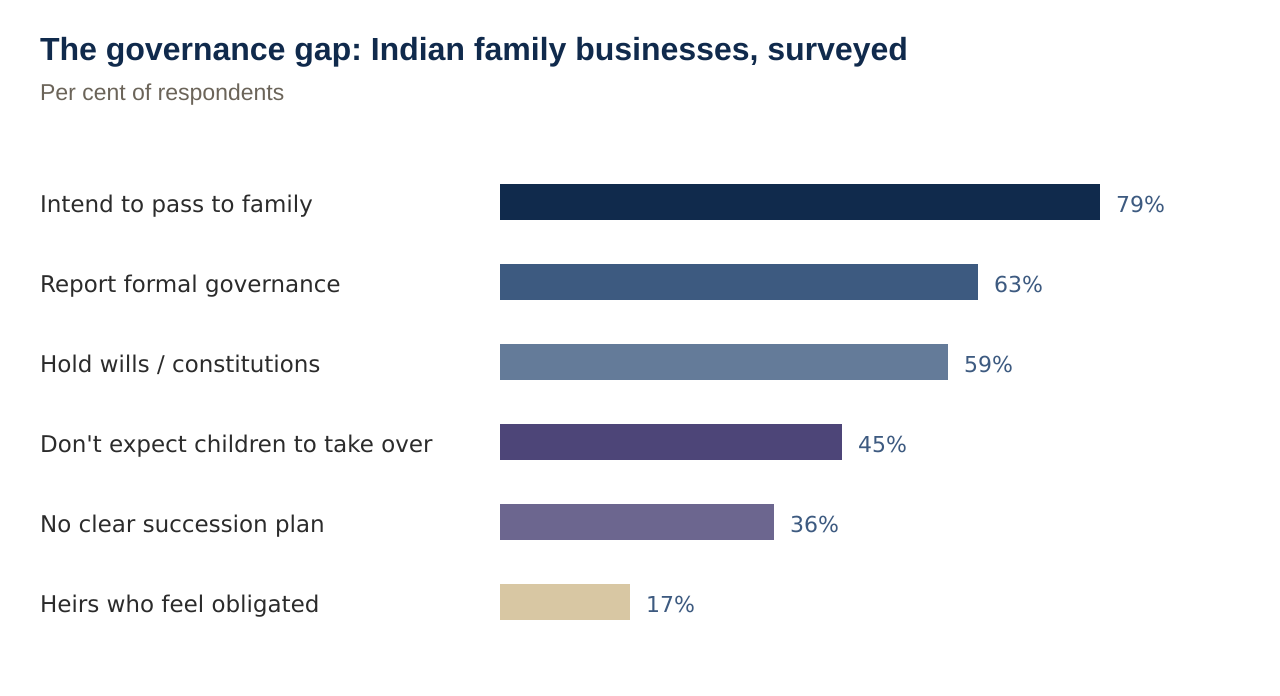
The numbers describe a country mid-handover. Roughly 70 per cent of India's 334 billionaires are expected to pass on approximately $1.5 trillion to the next generation (a sum exceeding a third of GDP), and the pattern repeats, at smaller scale, across thousands of promoter families. Yet the state of preparation is sobering. Around 36 per cent of Indian family businesses report no clear succession plan; 52 per cent name resistance from the senior generation as the biggest barrier; and while 79 per cent of founders intend to pass the business to family, 45 per cent do not actually expect their children to take over. Only 17 per cent of heirs feel obligated to join at all.
Nine in ten listed Indian companies are family-owned or family-controlled, yet only 63 per cent of their leaders report having any formal governance architecture: a shareholder agreement, a family charter, even a basic will. That gap between the scale of ownership and the maturity of governance is precisely where generational wealth quietly erodes: contested wills, boardroom stalemates, forced sales at the worst possible moment. India's business press supplies fresh case studies every year.
What a constitution is, and is not
A family constitution is not, by itself, a legally binding contract. It is the family's operating manual: a written codification of values, decision rights, employment criteria for family members, dividend policy, dispute-resolution mechanics and exit conditions, agreed before emotions run high, precisely so that it never has to be litigated. Its force comes from pairing: the constitution sets the intent, while legally binding instruments (trust deeds, shareholder agreements, wills, powers of attorney) give that intent teeth. Families that hold one report dramatically fewer disputes and smoother transitions, and the direction of travel is clear: roughly 59 per cent of Indian families now have wills or constitutions in place, and per PwC's India Family Business Survey, about 40 per cent have established private trusts to hold equity, real estate and family assets.
A succession plan that exists only in the founder's head is not a plan. The constitution's real work is done in the writing: the arguments had early, on paper, instead of late, in court.
The Private Research Desk
Two Indian specifics deserve emphasis. First, daughters are equal coparceners under the 2005 amendment to the Hindu Succession Act (with equal rights to demand partition and to serve as Karta), and a constitution that has not internalised this is already obsolete. Second, India currently levies no inheritance tax, estate duty having been abolished in 1985; but the absence of estate tax is not the absence of tax, since heirs inherit the original cost basis and lifetime transfers outside specified relatives can be taxable. The recurring policy debate around reintroducing estate duty is itself a reason to structure early, while the window is unambiguous.
Constitution, council, trust: the working triad
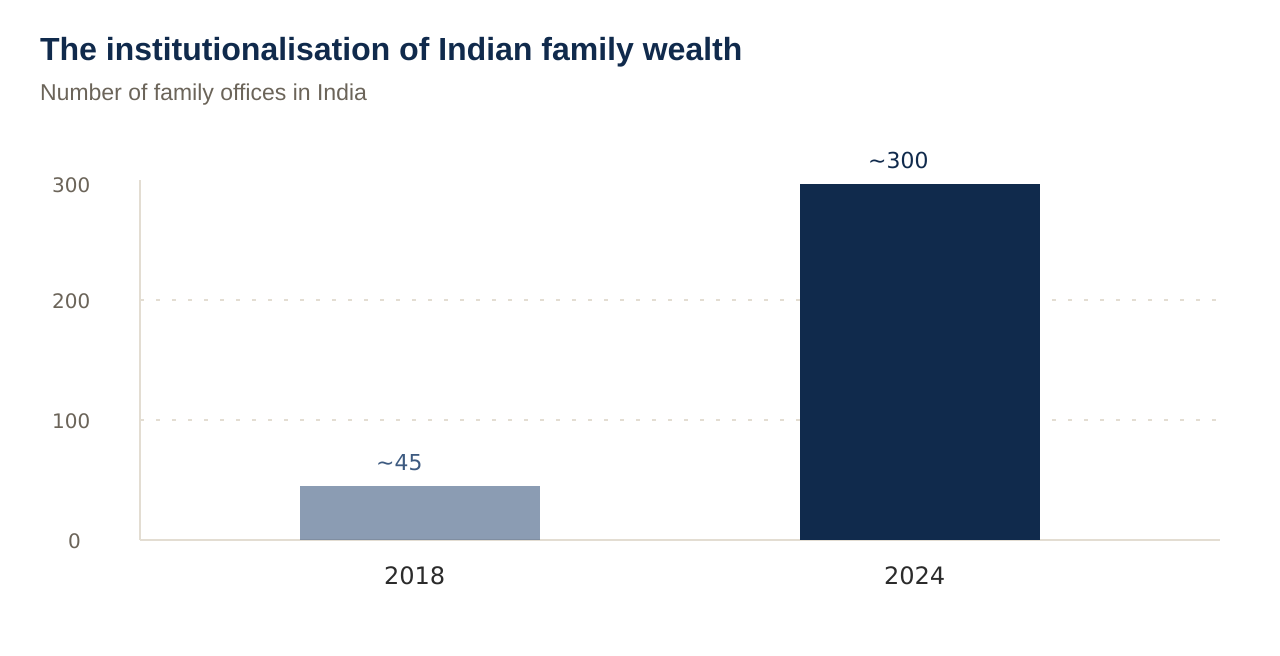
In practice, durable governance settles into three layers. The constitution states the rules. The family council, a standing forum with agreed membership and cadence, applies them, keeping business questions out of the dining room and family questions out of the boardroom. The holding structures (typically private trusts, increasingly favoured over the partition-prone HUF) execute them, ring-fencing assets and enabling transfer without fragmentation. The institutional shift is measurable: India's family offices have grown from roughly 45 in 2018 to nearly 300 by 2024, and a Fortune India analysis finds 38-plus billionaires with about a quarter of their combined wealth (some ₹32.5 trillion) already secured in private trusts.
Governance before the transition, not during it
The single most common failure we observe is sequencing: families draft wills and settle trusts before the fundamental decisions (who leads, who owns, how disagreements end) have actually been made. The constitution belongs first, because it is the decision-making machinery for everything that follows. It also solves the problem equal division cannot: separating ownership from management, so the child running the business is compensated for running it, while ownership follows the family's agreed principles rather than arithmetic that satisfies no one. Begin years before the transition is expected; involve a neutral facilitator; and revisit the document as the family changes. Wealth rarely fails between generations for lack of returns. It fails for lack of rules.
- Kotak Neo, "India's Family Business Reset" (Feb 2026): ~70% of India's 334 billionaires passing ~$1.5tn; 36% without clear succession plans; 52% citing senior-generation resistance; 79%/45% intention-versus-expectation gap; 17% heir obligation; 59% with wills/constitutions.
- Treelife, "Succession Planning in Indian Family Businesses" (2026): nine in ten listed Indian companies family-owned/controlled; only 63% reporting formal governance structures; common failure modes.
- Law.asia / Shardul Amarchand Mangaldas (June 2026): family offices growing from ~45 (2018) to ~300 (2024); $1.5tn+ transfer over the next decade; constitutions gaining force when paired with binding instruments.
- Chambers & Partners, "Succession & Estate Planning 2026 - India": PwC India Family Business Survey 2025 (~40% with private trusts); Fortune India analysis of 38+ billionaires with ~₹32.52tn (~$357bn) in private trusts; no rebasing of inherited assets.
- DealPlexus and IB Grid succession guides (2026): estate duty abolished 1985; S.56(2)(x) considerations; the 2005 Hindu Succession Act amendment on daughters' coparcenary rights; HUF partition risk versus trusts; sequencing and facilitation practice.
This publication is for information only and does not constitute legal or tax advice. Succession structures depend on personal law, residency and family circumstances; obtain professional advice before acting. Figures are drawn from public sources believed reliable as of July 2026 but are not guaranteed. Threewords Capital Perspectives · Private Research Desk.